

What adopting Google's agentic platform actually looks like in practice, stage by stage: from the first grounded question to a governed fleet of AI agents.
It's 7:40 on a Tuesday morning, and a business analyst is doing what she does every morning: four browser tabs open, a spreadsheet waiting, a CRM window minimized, and forty minutes of manual copy-pasting ahead of her to assemble the briefing her team expects at ten.
Plenty of articles list what Gemini Enterprise can do. Far fewer show the order in which a real company actually meets those capabilities. Nobody adopts an agentic platform all at once, and the order matters more than the list.
So this is that journey, told as one company's story: a composite of the adoption paths I see working with enterprise teams, compressed into a 30-day arc, set on the platform as it ships this summer. Anonymized and simplified, yes. But every stage reflects how these capabilities land in practice. And the analyst is our guide: she starts the story doing competitive research by hand and ends it supervising a small fleet of agents that do the gathering for her.
If you're evaluating the platform, don't read this for any single feature. Read it for the sequence. The sequence is what turns an AI license into an operating capability.
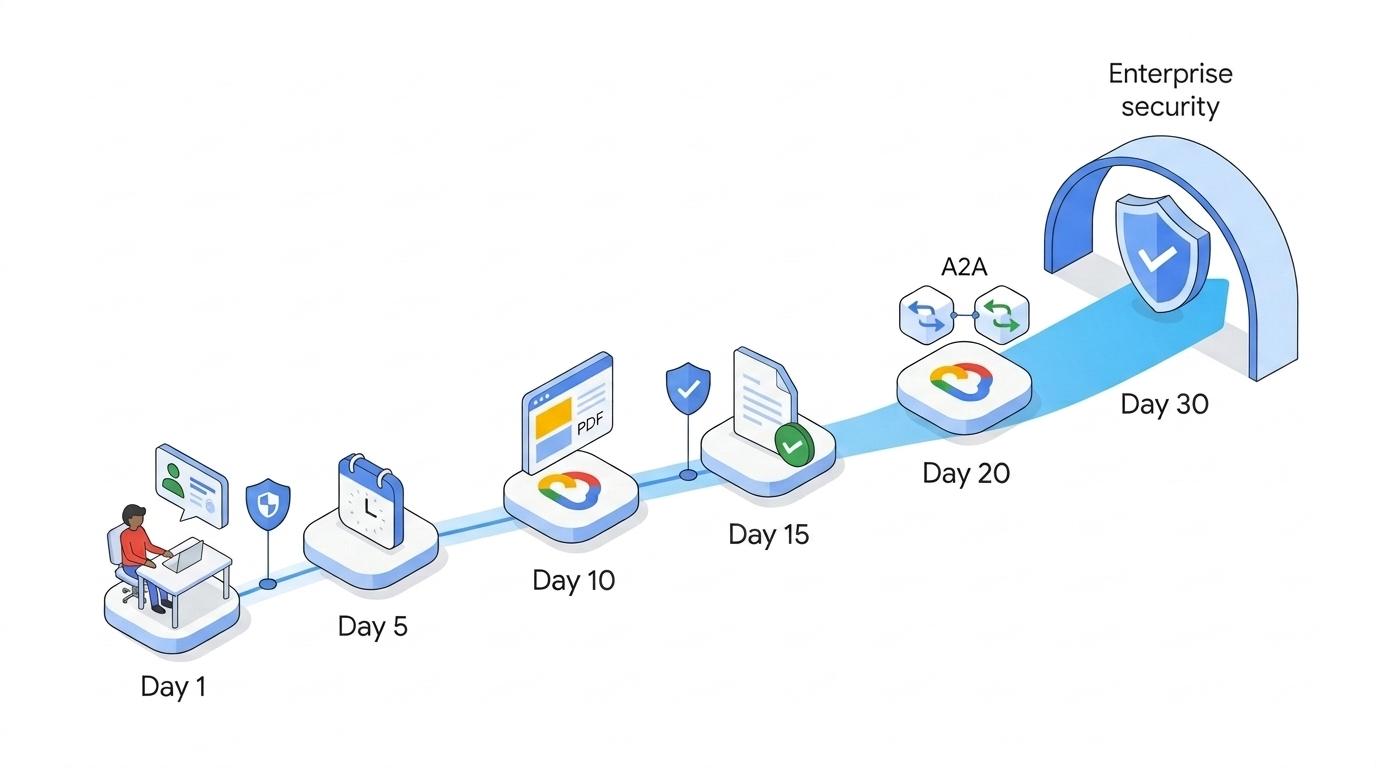
Executive Summary: Operational Shift & Real-World ROI
Before Day 1, here is what published Gemini Enterprise deployments already look like at scale:
| Gemini Enterprise Customer | Published Result |
|---|---|
| Macquarie Bank | 100,000+ hours reclaimed |
| Virgin Voyages | 1,000+ specialized agents, campaigns 40% faster |
| GE Appliances | 800+ agents, 25% fewer backorders |
| KPMG | Nearly 700 no-code agents built by employees in the first weeks |
All figures as published by Google Cloud or the customer. Evidence of the platform at scale, not a forecast for this composite story.
Now let's walk the path to these numbers one stage at a time.
Day 1: Ask Before You Automate
Her mornings are the "before" picture: win rates live in Salesforce, margins in last week's strategy doc, market chatter in email, and she is the only integration layer between them. When the rollout was announced, her first reaction wasn't excitement but the question every analyst asks quietly: if this gets automated, what happens to my job?
Leadership's answer set the tone for everything that followed: her value was never the copy-paste; it was the judgment. So the deployment doesn't start with agents. It starts with questions.
Gemini Enterprise connects to the systems the company already runs on: Google Workspace, Jira, Salesforce (its connector is in preview), internal databases, and a connector catalog that keeps growing. The complete connector list is in the documentation. "Set up once" still means real work: identity, access scoping, and a security review. That review is the company's first real governance decision, and it is simpler than it sounds, because access is permission-aware: an agent only ever sees what the person behind it is authorized to see in the source system. And whatever flows through those connections, customer prompts and outputs are never used to train Google's foundation models; your data remains entirely yours (Google Cloud data governance commitments).
What makes Day 1 powerful is dual grounding: a question can pull from both real-time Google Search web context and the company's internal systems (Google Workspace and Salesforce). Every response comes back with inline citations, so the analyst can check the lineage of any number instantly.
For the analyst, Day 1 just means better answers, faster:
- "What are our current win rates against this competitor, and what recent market pricing announcements have they made this week?" [Grounded in Salesforce + Google Search]
- "What margin floor did we land on in last week's strategy deck?" [Grounded in Google Workspace Drive]
One place to ask, grounded in verified internal and public data, with zero tab-hopping.
This stage looks unglamorous next to the agent demos, and it's the one I'd least recommend skipping. The teams that get real value from agents later are the ones whose people first learned to trust, and sanity-check, what the platform says about their own data. She did both. It matters later.
Day 5: The First Agent Is a Schedule, Not a Coder
The first automation doesn't come from IT. By Day 5, it comes from the analyst noticing that she asks the same three questions every morning before the 10 a.m. meeting.
That's what Agent Designer is for: a visual, no-code interface built right into the Gemini Enterprise app. She describes what she wants in plain language, arranges the steps on a drag-and-drop canvas, and puts the whole thing on a daily 7:30 a.m. schedule. Version one of her morning briefing covers internal data only, and it already buys back the first hour of her day.
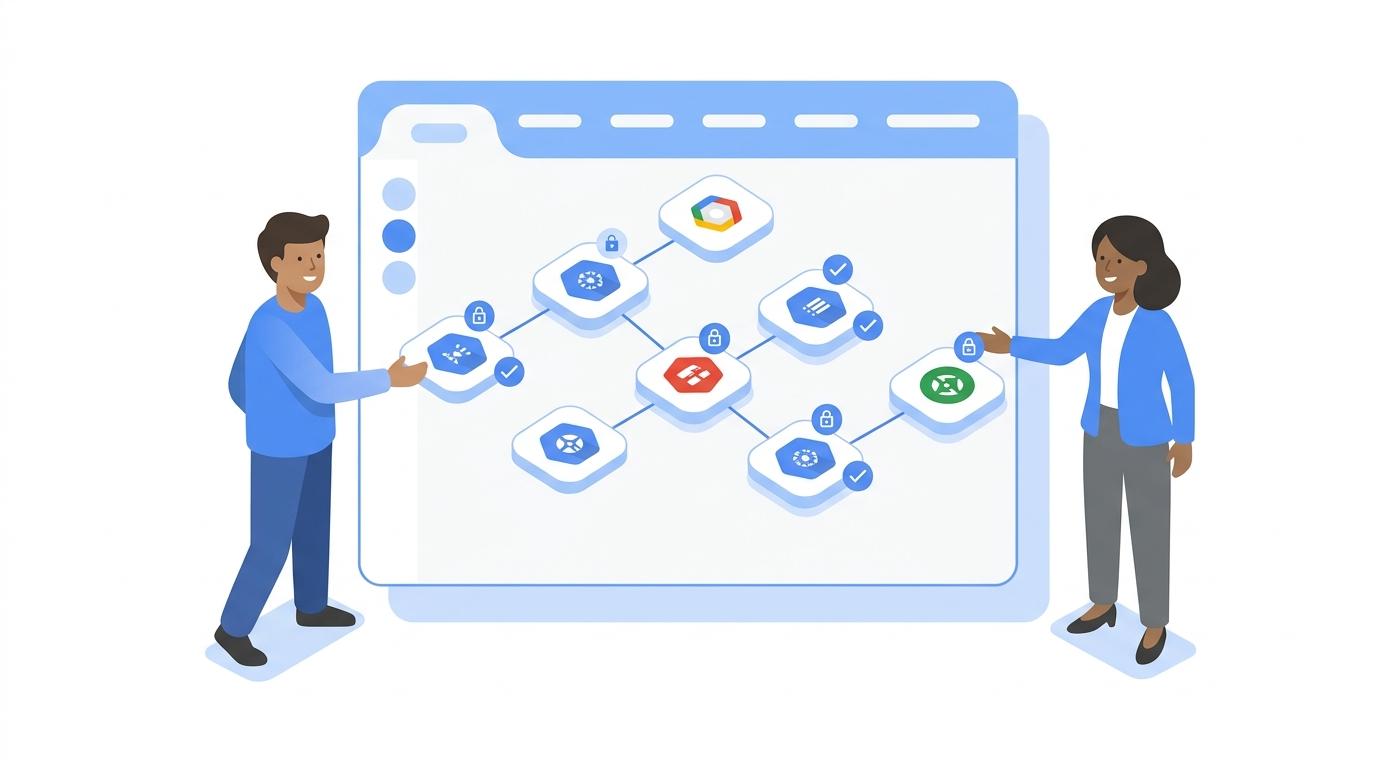
Just as important is what happens when things change. A business lead notices a new competitor entering the market and wants it tracked by tomorrow morning, so they adjust the agent themselves on the same canvas, point it at the new sources, and run it. No code, no IT ticket.
Day 10: When the Data You Need Lives Outside
By Day 10, the team hits the wall every competitive-intelligence effort hits: the most valuable data isn't in any connected system. It lives on the open web as dynamic content: interactive charts you filter and click through the way a person would, downloadable PDF catalogs, pages that get redesigned often enough to break any traditional scraper, or worse, leave it quietly returning stale numbers.
She can't fix that herself, so she flags the gap, and the first move is plumbing, not agents. Developers extend the catalog with custom connectors: the partner portal, the internal market database, even a legacy ERP sync into the same governed, permission-aware index everyone already searches, and a custom MCP server gives live access where syncing doesn't fit. The open web is the frontier left over, and it calls for something that behaves less like a pipeline and more like a person.
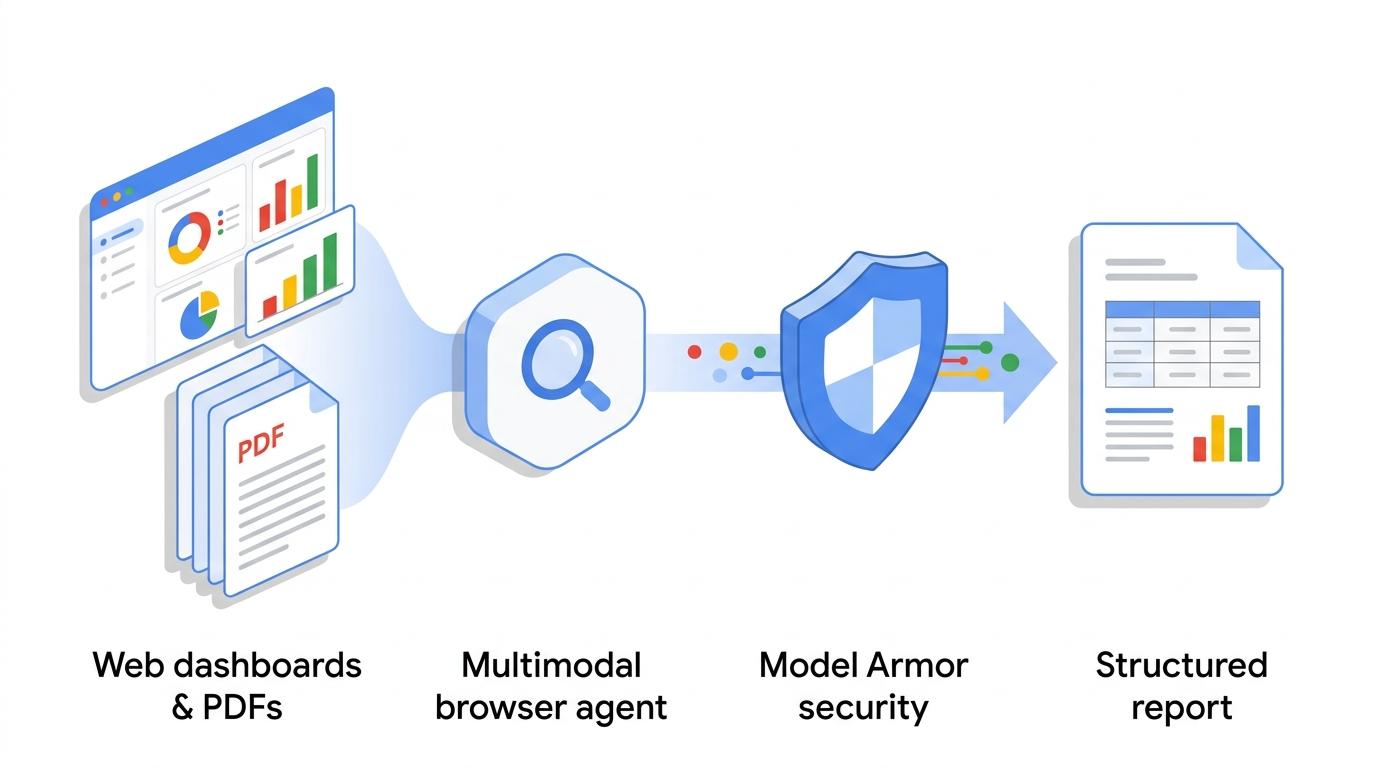
So the developers go further, on the platform's other half: within a week, a borrowed developer uses the Agent Development Kit (ADK) on the Gemini Enterprise Agent Platform to build a custom browser agent that reaches the web over MCP. Gemini's multimodal vision makes it work where scrapers fail: the model reads a page much like a person would, so interactive charts, PDF tables, and redesigns don't stop it, and every site comes back as the same structured report.
Visual agents aren't infallible, so governance arrives with the first build rather than after it, as two safeguards: evaluation pipelines that test every candidate version for accuracy and safety before production, and a rule for everything the agent produces: nothing ships unreviewed. Published to the Gemini Enterprise Agent Gallery for the rest of the team, the agent hands its findings straight into the morning briefing over the A2A (Agent2Agent) protocol, no person ferrying numbers in between.
Day 15: Where the Work Actually Lands
The gathering was solved. What the team met next, on Day 15, is where all that work actually lands: the outputs, and the review pass they still go through every morning.
Canvas is the workspace where the drafting happens, and it isn't locked to Google formats: documents come out as Google Docs, Word (.docx), or PDF, and decks as Google Slides, PowerPoint, or PDF. When the VP wants today's analysis as a ten-slide deck highlighting where their pricing has the edge, that's a request the analyst types, not a project she scopes.
The deep reading has a home of its own, too: Gemini Notebook Enterprise, aka NotebookLM Enterprise, built directly into the platform. The analyst loads the quarterly reports, strategy decks, and the agents' collected filings into a notebook and gets grounded answers, summaries, and audio overviews that cite only the sources she loaded, under the company's access controls. For the deep-dive work that precedes a big call, it has quietly become where she thinks.
By now her job description has quietly changed: she doesn't assemble the morning briefing anymore, she judges it: the flagged figures, the surprising price drop, the call on what it means for strategy. Her manager made it official: her KPIs no longer count the reports she produces, they weigh the quality of the judgment she adds. The quiet question from Day 1, answered.
Day 20: The Fleet Grows Beyond One Team
By Day 20, the morning briefing has an audience beyond the strategy team, and other departments start asking the obvious question: if agents can handle competitor analysis, what else can they do?
The first discovery is that not everything needs to be built. The Agent Gallery ships with Google-made agents that deliver value from day one. The analyst now starts her deeper competitive dives with Deep Research, which plans, searches, and drafts a sourced report she then interrogates, and the R&D group picks up Co-Scientist, generating and stress-testing hypotheses alongside the scientists. Her custom analysis agent supplies the fresh numbers; the prebuilt agents do the long reading.
The second discovery is that her team was only the beginning. Marketing builds campaign agents on the same Agent Designer canvas, sales assembles briefing agents for account reviews, HR drafts onboarding flows, and finance wires up report checkers. Marketing goes furthest: with image generation on Nano Banana and video generation on Veo built into the platform, campaign visuals and product clips come out of the same workspace as the copy.
And Skills, reusable packages of instructions and code for the assistant, compound the effect on the everyday side: the prompts people repeat all day become one-click routines.
The pattern to notice is simple: what started as one analyst's morning automation is becoming a company-wide capability, running through the same workspace, with a human still deciding what ships.
Day 30: Governing the Fleet, the Part the Demos Skip
Remember "no code, no IT ticket"? Multiply that freedom by a dozen agents talking to internal systems, external websites, and each other, and by Day 30 the governance that has been accumulating piece by piece, the security review, the evaluation pipelines, the review rule, needs to become an explicit system. The question changes from "can we build one?" to "who is allowed to talk to what?"
Gemini Enterprise's answer starts with visibility. Built-in analytics give leaders a high-level view of adoption, query volumes, and success rates, while developer-level traces in the Agent Platform show what each custom agent actually did: which tools it called, what path it took, what it cost in latency and tokens. Underneath the visibility sits control. Every agent the company runs is registered centrally, and egress policies decide what each one may reach; anything not registered is blocked by default. And Model Armor extends the protection to the content itself. Enabled on every Gemini Enterprise app, it screens prompts and responses for indirect prompt injections, jailbreaks, and sensitive-data leakage, for every user, not just the custom builds.
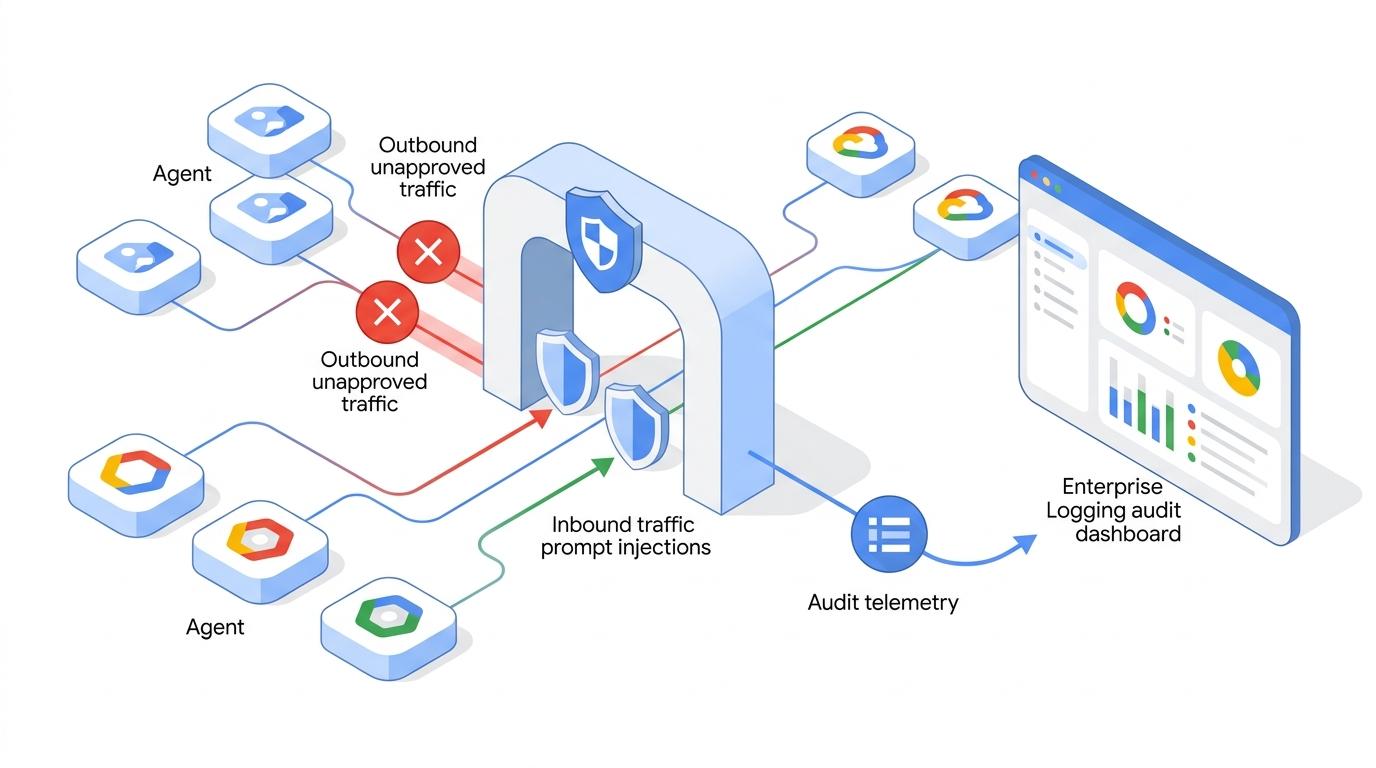
In our story, the payoff shows up in how much autonomy the team can now afford. The browser agent is a genuinely dynamic crawler: nobody scripts its steps. The model works out its own strategy for every website it visits, adapts when layouts change, and still returns the same structured report every time. Unmanaged, that much freedom would be alarming. Bounded by registry policies, logged for the platform team's audit trail, and surfacing its findings in the briefing the analyst scans each morning, it is just another governed worker: when a newly onboarded team's agent reaches for a customer-data source it has no business touching, the attempt is blocked by policy and logged, before anyone had to notice, let alone react.
Governance matters for a second reason: the platform underneath you doesn't stand still. Model upgrades and feature rollouts arrive on Google's schedule, not yours. This is where the evaluation pipelines from the Day 10 build earn their keep a second time: they re-run before production agents pick up a new model, and combined with pinning to stable model versions and central policies, that is how an organization absorbs rapid AI updates safely instead of being caught off guard.
The Takeaway: Capability Is a Sequence, Not a List
Look back at the 30 days and the feature names almost don't matter. What matters is the order: learn to trust grounded answers, schedule the routine, extend to multimodal data outside your walls, keep people on judgment instead of assembly, let the fleet spread beyond one team, then govern the whole of it. Each stage created the confidence, and the guardrails, the next one needed. Skip one, and you either stall at the demo stage or meet Day 30's question the hard way.
And the analyst? It's 7:40 on a Tuesday morning again. The fleet gathered overnight; the briefing is waiting for her with two figures flagged. She reads, questions one number, and approves. That is the quiet result of the whole journey: at every point where something ships, a human now sits at the decision, and the expertise she spent years building is what the fleet amplifies rather than replaces. The direction of travel for these platforms is clear: from agents that assist work, to agents that do it, to agents that improve how it's done. But the last word in the chain is still hers.
Closing & Next Steps
If you're mapping your own organization onto this 30-day journey, the useful exercise takes a minute: name the stage you're actually at, and be honest about the one you're tempted to skip; that's where the risk is hiding.
- 🎯 For Business & Operations Leaders: Plan your own 30-day sequence with OREDATA: we run Gemini Enterprise workflow workshops that map your highest-value automations first.
- 🛠️ For Technical Architects: Talk to OREDATA's engineering team about custom agent capabilities on the Gemini Enterprise Agent Platform.


